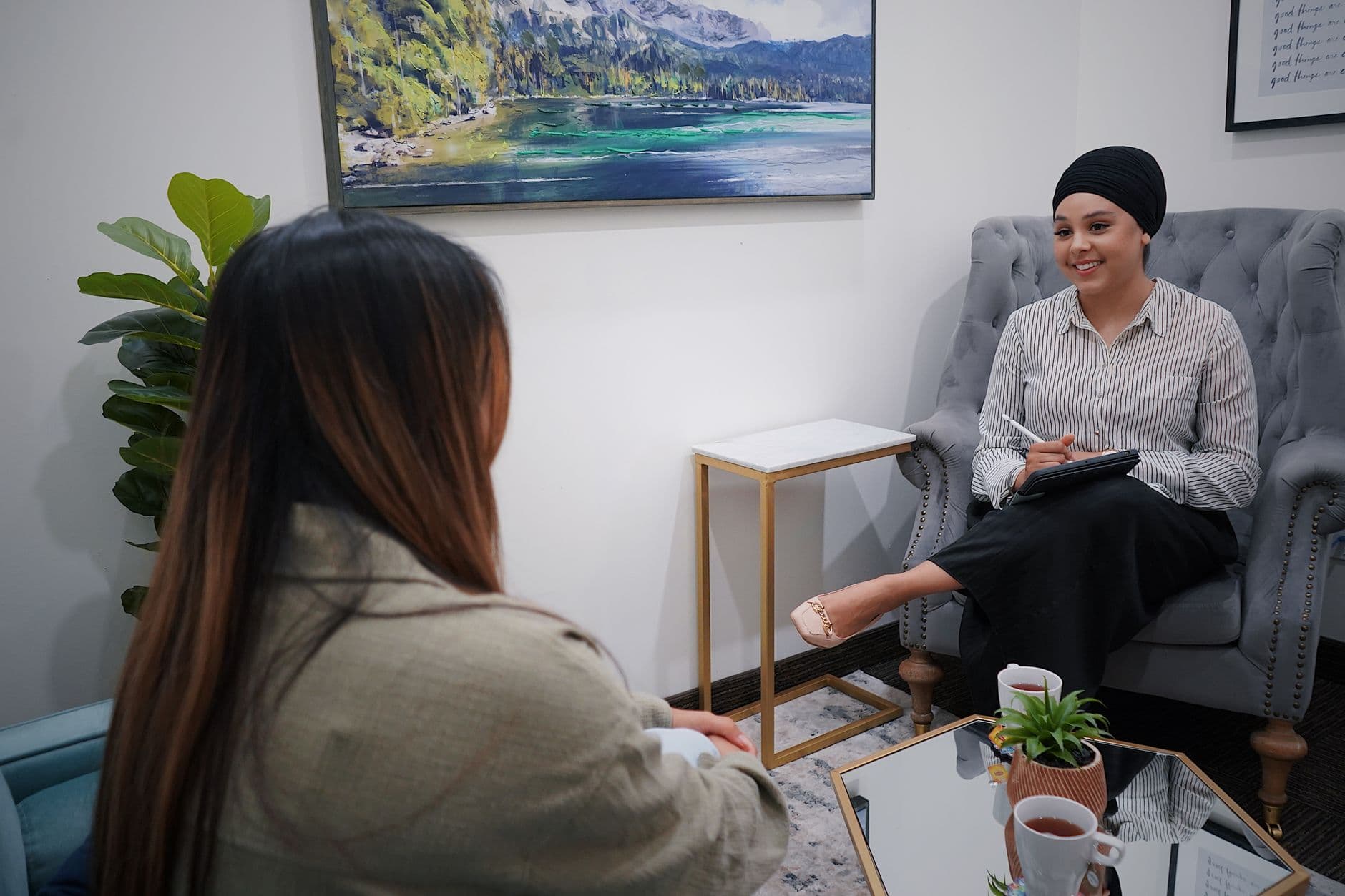
It was 2019. I was tired. Not the kind of tired that sleep fixes. I was tired of feeling sad every single day and not fully understanding why. I was having suicidal thoughts and I did not have language for what was happening inside me. I just knew I needed help. Real help.
When I finally got ready to search, really ready, I knew one thing immediately: I needed a woman of color.
Not because I had a political reason. Because I was exhausted by the idea of spending fifty minutes a week explaining things that should be the starting point, not the whole session. Things like why my parents were so strict. Why their faith shaped how they disciplined us and why that left marks. Why I had repressed memories I did not even know were there yet. And beyond that: I did not know who to talk to about them. In my family, you did not talk about these things. It was not something that was done. Not culturally, not in our home. You kept it inside. You managed. And so I had kept all of it inside for years, without even knowing it was sitting there. Why growing up in a neighborhood where I was one of the only BIPOC people left something in me I could not name.
I did not want to teach. I wanted to heal.
I searched partly by proximity. Her office was not far from where I lived. And I got lucky in a way I did not know was luck at the time. She was a woman of faith. She understood the intersection of spirituality and pain in a way I had not known I needed. She helped me find my inner child. She helped me understand what I had been carrying and what had been done to me.
She got it. Not because I explained it. Because she already knew.
That is the whole point of this post.
You Are Not Imagining It. The System Was Not Built for You.
Here is a number that should make you angry: Black psychologists make up approximately 2% of the mental health field in Canada.
Two percent.
That means when you go looking for someone who shares your lived experience, your cultural context, your relationship with faith, your family dynamics, the particular exhaustion of being the only one in every room, the math is already against you.
And then there is this: only 38% of Black Canadians experiencing poor mental health actually access mental health services, compared to 50.8% of white Canadians. The gap is not about willingness. It is about trust. And trust is built when you feel understood.
The silence people carry into therapy waiting rooms is not about being closed off. It is about knowing from experience that you will walk out more tired than you walked in.
What People Are Actually Saying. But Not Out Loud.
These are real. Every single one.
“I spent the whole session explaining why my mom's silence wasn't neglect. It was survival.”
“She kept asking me why I didn't just set limits with my family. She had no idea what she was asking.”
“I don't want to be fixed. I want someone to say ‘same.’”
“Every time I try to talk about it, I end up having to educate someone first. I'm so tired.”
“I'm breaking cycles alone. And it's lonely as hell.”
“I needed someone who already understood the context. I didn't have the energy to give them the backstory.”
“I kept performing fine. Until I couldn't anymore.”
None of these people lack insight. None of them are unwilling to do the work. They are exhausted by a system that asks them to arrive already depleted and keep giving.
Why It Actually Matters That Your Therapist Gets Your Culture
This is not about preference. The research is clear.
Clients from racialized communities report significantly stronger therapeutic alliances (the relationship between client and therapist that predicts outcomes) when their therapist shares or deeply understands their cultural background. A stronger alliance means more honesty. More honesty means more actual healing.
When you have to spend session time explaining your cultural context, you are doing emotional labor that depletes the very energy you came in to replenish. And you are less likely to tell the full truth. Because part of you is managing their reaction.
It means they already understand:
- Why “just talk to someone” is not as simple as it sounds in communities where silence was survival
- Why faith and mental health are not separate conversations for many BIPOC people
- Why setting limits with family can carry real social, financial, and spiritual consequences
- Why you may have repressed things you are not even aware of yet
- Why you have been performing fine for so long that you have lost track of what fine actually feels like
How to Find a Therapist Who Understands Your Culture in Canada
This is the practical part. It should not be this hard. But until the system changes, here is how to move through it.
Directories built for this:
- Therapy for Black Girls, therapyforblackgirls.com, directory and podcast
- Inclusive Therapists, inclusivetherapists.com/canada, liberation-oriented, filters by identity
- Psychology Today Canada, psychologytoday.com/ca, filter by “Black/African descent,” “Caribbean,” “faith-based,” or “culturally sensitive”
- CAMH, camh.ca, including their CA-CBT for Black Populations program
Questions to ask before you commit:
- What training have you had in cultural competency or anti-racism?
- Have you worked with BIPOC clients navigating intergenerational trauma?
- How do you approach the role of faith or spirituality in mental health?
- What experience do you have working with clients from my community specifically?
You are interviewing them. That is allowed.
Red flags:
- You feel the need to soften or explain your reality to protect their comfort
- They seem surprised by things that should not be surprising
- They reduce complex cultural dynamics to “communication issues”
- They have never heard of intergenerational trauma or dismiss it quickly
You Deserve Someone Who Already Knows the Context
The therapist I found in 2019 did not need me to explain why faith was complicated. She did not need me to justify why I had not talked about certain things before. She worked with spirituality. She understood cultural context. She helped me find things in myself I did not know were buried there. And she helped me understand that out of our struggles, we unearth strengths hidden below the surface of who we are.
I found her almost by accident. By proximity. By something in how she described her work that resonated before I even sat down.
Not everyone gets that lucky. You should not have to be lucky.
The shortage of BIPOC therapists in Canada is a systemic problem. Advocacy matters. Funding for culturally competent training matters. Representation in psychology programs matters.
But while that work happens, you still need to heal now.
Use the directories. Ask the questions. Trust the discomfort when it shows up in the first session. And know that finding the right person is not weakness. It is the opposite.
While You Are Still Looking
This is part of why The Miracle Rise exists.
The Miracle Rise is a one-day gathering built specifically for BIPOC professionals who are tired of healing alone. Not a therapy session. Not a wellness perk. A room where you do not have to earn the right to be honest. It is on pause for now, and the list hears first when it returns.
While it is paused, support CAMH, the mental health resources this movement is built around.
In Support of CAMH
Your donation funds mental health resources for communities that need them most.
Every dollar goes directly to CAMH Foundation. Your PAX tax receipt is issued immediately.
Give to CAMHNot ready yet? Break the silence on The Wall
If you are in crisis right now
Crisis Services Canada: 1-833-456-4566 · Text HOME to 686868 · CAMH Resources
Lydie Jean is the founder of Unleash Unrepeatable You and the creator of The Miracle Rise™, in support of CAMH.
Sources
- CBC News: Black and Indigenous psychologists say there are not enough of them in Canada (2021)
- Statistics Canada: Mental health care access by racialized group
- Centre for Addiction and Mental Health (CAMH): CA-CBT for Black Populations Manual (2024)
- PMC / National Institutes of Health: Making cross-racial therapy work (2010)
- Inclusive Therapists Canada: inclusivetherapists.com/canada
- Psychology Today Canada: psychologytoday.com/ca