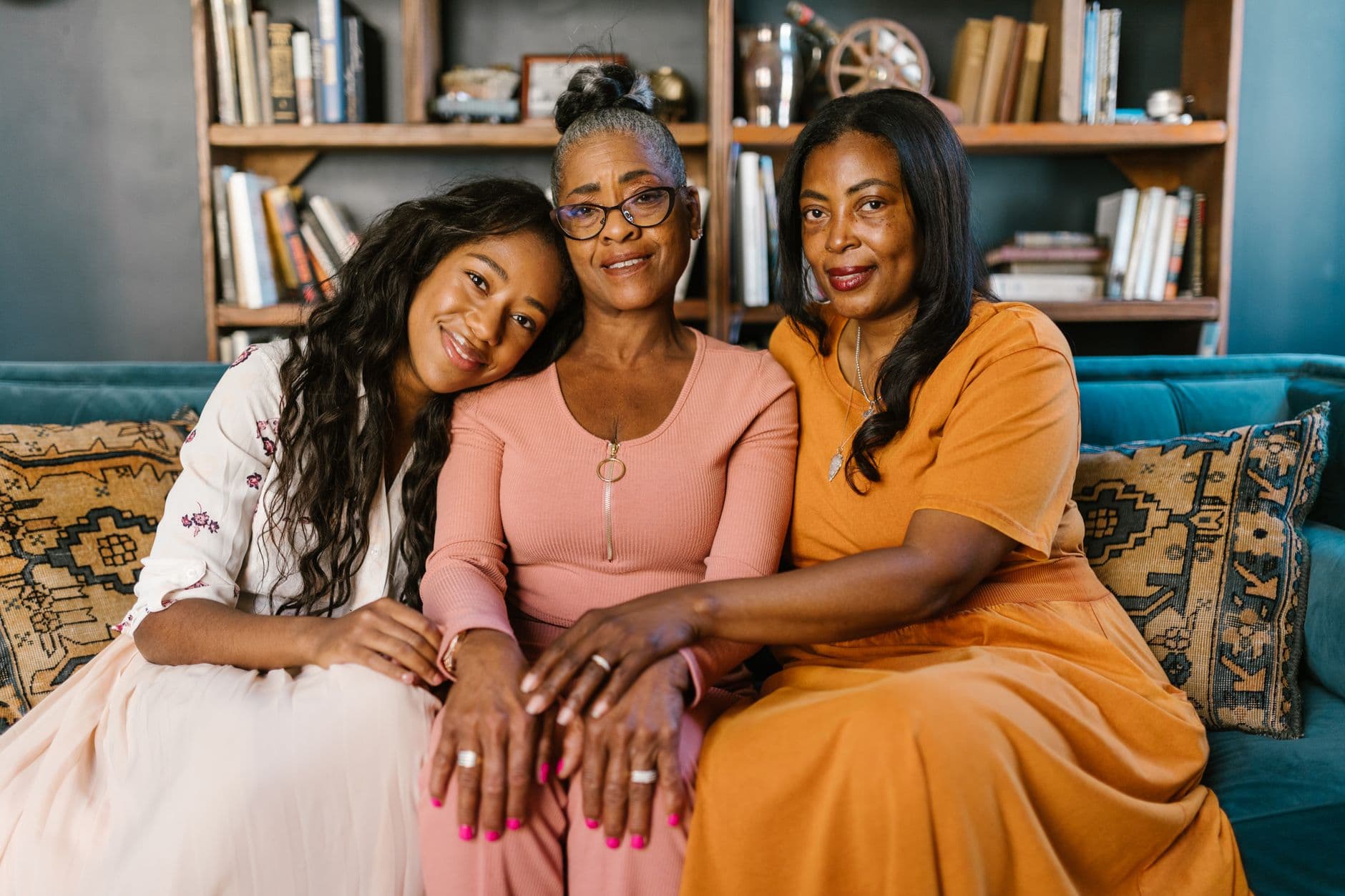
Somewhere between your grandmother and you, a set of instructions got handed down. Not in words. Nobody sat you down and taught you to apologise for resting, or to keep bad news to yourself until you had already solved it, or to say you were fine while your jaw was locked.
You learned it the way everyone learns the things that matter most. By watching.
Intergenerational trauma healing for Black women usually gets talked about in one of two ways. Either it is a vague online phrase that explains everything and changes nothing, or it is a story about DNA, as if the pain was written into your cells and there is nothing to be done. Both of those get in the way. The useful version is more specific, and the research is more hopeful than the internet version suggests.
What actually got passed down
Start with the part that is not in dispute. Trauma travels through families. The argument is about how.
Dr. Joy DeGruy spent years building the framework most people have heard of, Post Traumatic Slave Syndrome. Her argument is that centuries of chattel slavery, followed by generations of legal and social oppression that never allowed for repair, left patterns in behaviour, self-perception and community life that outlived the original injury. It is a framework for understanding a legacy, not a diagnosis in a manual, and read that way it explains a great deal about the rules in a Black family.
Think about what those rules were built to do. Do not draw attention. Do not need anything publicly. Be twice as good. Keep the family business inside the family. Every one of those was protective. They kept people alive and employed and out of danger in conditions designed to do the opposite. The problem is not that your grandmother was wrong. The problem is that a rule written for a burning house is still running in a house that is not on fire.
The DNA story, and what the research really says
You have probably seen the claim that trauma is passed down in your genes, and that the proof is in the epigenetics. That claim usually points at the work of Rachel Yehuda, who studies trauma in Holocaust survivors, combat veterans and their children.
Here is what her own 2018 review in World Psychiatry, written with Amy Lehrner, actually concluded. Changes have been documented in people whose parents were exposed to trauma. But the studies have not conclusively demonstrated that trauma effects are transmitted epigenetically in humans. The strongest evidence comes from animal studies, where researchers can control the conditions. In people, you cannot easily separate biology from the environment a child grows up in, and much of the human work has leaned on a small number of stress-related genes.
The scientists closest to this work are the most careful about it. That care is good news for you.
If what you inherited were purely genetic, healing would mean waiting for biology to let you go. What the evidence supports is less poetic and far more useful. What reliably moves from one generation to the next is behaviour. Parenting. Silence. What gets named at the dinner table and what never does. Those are learned, which means they can be unlearned, and that is where the work actually happens.
How it travels in real life
Researchers studying adverse childhood experiences have found that the effects reach past the person who lived them. A parent's own childhood adversity shows up in the next child's development, and parenting practices are one of the main routes it takes. A mother who was never comforted is not withholding comfort on purpose. She is giving what she was given.
For Black families there is a second layer. Racial socialisation, the work of preparing a child for a world that will treat her differently, protects children and costs the parent something to deliver. The same conversation that keeps a daughter safe also teaches her that the world is watching. Both things are true at once.
So the inheritance arrives as ordinary daily instructions:
Rest has to be earned. You can sit down when everything is done, and everything is never done.
Do not say it out loud. Pain gets mentioned only after it is handled, if at all.
Need nothing from anyone. Hyper-independence looks like strength on a resume and like loneliness at 11pm.
Money is a family matter. Your raise is a household raise, and saying no to a request feels like betrayal.
Be excellent, or be at risk. Perfectionism as a safety system, not a personality trait.
If the money and success part of that list landed, I wrote about it on its own in first generation professional guilt.
What this looked like for me
I am the firstborn of Haitian immigrants, and the rule I inherited early was simple: you work twice as hard and you ask for half as much. That rule saved my family in ways I will always respect. It also taught me that naming pain out loud was not something people in my family did.
When I started doing exactly that, in therapy and in how I talk to my nieces and nephews, it did not feel like healing at first. It felt like betrayal. Keeping the parts of the pattern that saved us while refusing to pass on the parts that hurt us took me years to understand as loyalty rather than treason. I wrote the fuller version of that in what is a cycle breaker.
What actually helps
Name the rule, not the relative.“We do not ask for help” is something you can examine. “My mother was cold” is a verdict, and verdicts go nowhere. Write the rule as a sentence. You cannot decline an instruction you have never read.
Ask what the rule was protecting. Every one of these started as a survival strategy in conditions you probably did not live through. Respect for the origin is what makes it possible to retire the rule without putting your family on trial.
Pick a therapist who does not need the history explained. Family therapy researchers have argued for approaches that combine trauma-informed care with attention to culture and race, rather than treating a Black family's history as background noise. You want the person who already knows the context. Here is how to find a Black therapist in Canada.
Change one instruction at a time, in public. Say the hard thing at the table once. Ask for help with something small in front of your children. The rule is transmitted by what gets modelled, so it is also broken by what gets modelled.
Collect the strengths too. Work on adverse childhood experiences increasingly looks at protective factors alongside harm, because resilience also runs in families. Your humour, your resourcefulness, the way your people show up when something goes wrong: that is inheritance as well, and it is worth naming out loud as often as the rest.
Do not do it alone. The instinct to heal privately is the same rule you are trying to change. I wrote about why solitude stalls exactly here in healing alone vs in community.
You are not the family's critic
The fear underneath all of this is that examining the pattern means indicting the people who raised you. It does not. Your grandmother did not have a therapist, a word for what happened to her, or an afternoon free to think about it. She had a job to do and people to keep alive.
You are the first one in the line with the time, the language and the room to look at the instructions and decide which ones to keep. That is not a betrayal of what she did. It is the whole point of it.
Start Here
Build one page that takes money, in 45 minutes.
A free live workshop. You watch me build a page that can take payment, with Claude, spending nothing on tools. You leave with your own.
Save my seat →Or join The Unshrinkable Room for free and stop doing this by yourself.
If you are struggling right now, you are not alone. In Canada, you can call or text 9-8-8 anytime for free, confidential crisis support.
Lydie Jeanis the founder of Unleash Unrepeatable You. A firstborn daughter, recovering yes-woman, and cycle-breaker, she helps BIPOC women build mental wealth and stop performing strength at the cost of themselves. She is the creator of The Miracle Rise, Toronto's founding Mental Wealth gathering.
Sources
- DeGruy, Post Traumatic Slave Syndrome: America's Legacy of Enduring Injury and Healing (2005)
- Yehuda and Lehrner, Intergenerational Transmission of Trauma Effects: Putative Role of Epigenetic Mechanisms, World Psychiatry (2018)
- Lee and colleagues, Addressing Intergenerational Trauma in Black Families: Trauma-Informed Socioculturally Attuned Family Therapy, Journal of Marital and Family Therapy (2023)
- Felitti and colleagues, Relationship of Childhood Abuse and Household Dysfunction to Many of the Leading Causes of Death in Adults (the ACE Study), American Journal of Preventive Medicine (1998)
- Charting a Course towards Resilience Following Adverse Childhood Experiences: Addressing Intergenerational Trauma via Strengths-Based Intervention
- Centre for Addiction and Mental Health (CAMH): camh.ca