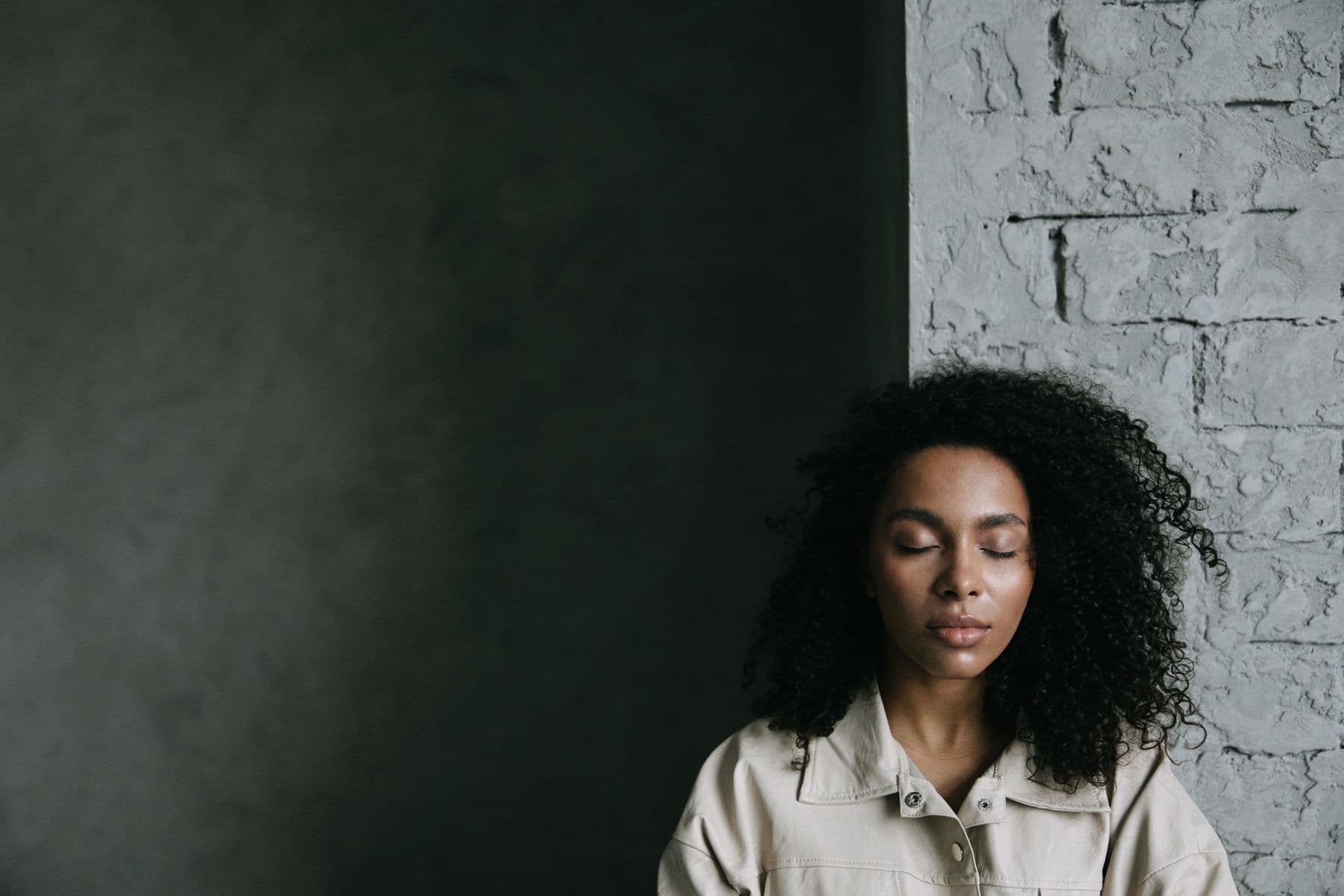
The day ends. You close the laptop. Nothing is on fire, nobody needs anything, and there is no reason your chest should still be doing that. You put on a show you have already seen. You are tired in a way that sleep does not seem to touch.
Then Sunday night arrives and you feel it start again before Monday has done anything to you.
Nervous system regulation for high achievers gets talked about as if the goal is to feel less stressed. That framing has never fit the women I work with, because they are not falling apart. They are performing at a high level while carrying something in the body that will not put itself down. The stress is not the problem. The not coming down is the problem.
What nervous system regulation actually means
Strip away the wellness language and it is simple. Your body has a system for meeting a demand, and a system for standing down afterwards. Regulation is not being calm. Regulation is having both directions available to you.
Going up is supposed to happen. You want your heart rate to climb before you present. You want the alertness before a hard conversation. That is the system working exactly as designed.
Coming down is supposed to happen too, and for a lot of us that half quietly stopped running years ago.
The problem is not the stress. It is the not coming down.
Bruce McEwen and Eliot Stellar gave this a name in 1993. Allostatic load is the wear and tear the body accumulates from repeated or prolonged stress, and what makes their model useful is that it does not treat all stress as one thing. It names several distinct ways the system goes wrong.
One is switching the stress response on too often. Another is a response that does not shut off after the stressor is gone. A third is a system that under-responds, so other systems overwork to cover for it.
Read the second one again. Failure to shut off after the stress is over. That is not weakness under pressure. That is a recovery problem.
If you have ever been told you handle pressure well, and also cannot explain why a quiet Saturday feels like waiting for something, that gap is the whole subject. You are excellent at going up. Nobody ever trained the other half.
Why high achievers are built for exactly this failure
Think about what gets rewarded. Responsiveness. Availability. Being the person who is already on it. Every one of those is a reason to stay slightly up, and every one of them pays you for it in praise, promotion, or simply not being the one who dropped something.
Then add the part that does not show up in the productivity books. If you are the only one in the room who looks like you, or the first in your family to be in that room at all, coming down is not just unpractised. It feels unsafe. Vigilance has been useful. It has caught things. You are not going to let go of a thing that works.
So the elevated state stops being a response to anything. It becomes the resting state. And because you are still producing, still delivering, still the reliable one, nothing in your life gives you the feedback that something is wrong. I wrote about that specific disguise in high functioning anxiety in BIPOC professionals.
What it actually costs
This is where I want to be careful, because the internet loves to tell women their stress is destroying them, and fear is a poor motivator for anyone already running hot.
Here is the accurate version. Short bursts of stress followed by real recovery are fine. They are adaptive. What the allostatic load literature associates with harm is the chronic version, the one without the coming down: effects on immune function, on the cardiovascular system, on metabolism, on sleep, and on the brain regions involved in memory and regulation.
The number that matters is not how much you can carry. It is how quickly you come back down once you put it down.
There is even a way to see it. Heart rate variability, the variation in time between heartbeats, is used as a marker of how well that braking system is working. In the neurovisceral integration model, Julian Thayer and Richard Lane linked this measure to the same neural networks involved in attention and emotional self-regulation. Lower resting variability tends to go with more vigilant, less flexible responses. The body and the ability to steady yourself are not separate projects.
What this looked like for me
I have spent a year and a bit building a business with an AI. At my desk, at the kitchen counter, at the dining table, on the sofa. This site alone is five hundred and sixty-eight versions, if you count the way a computer counts. I rebuilt the same page more times than I want to admit, changed my mind about the price and the name and the date, and then changed it back.
I used to read that as proof I could not commit to anything. Then I looked at when the work actually happened. My busiest hour is eleven at night. My second busiest is midnight. Ninety-two of those versions were made after everyone else had gone to bed.
The pattern goes like this. I tell myself I am stopping at ten. Then it is eleven. Then it is twelve, then one, then two, then three. There have been nights I got three hours, three to six, and the first thing I felt when I opened my eyes was the pull to go back to the laptop. Not dread. Pull.
My body kept the record. My back is wrecked. My shoulders hurt. For a while I had tingling in my fingers that I never got looked at, and I suspect it starts somewhere in my neck. All of that sat on top of the ordinary weight of a life doing what life does, because none of this was happening in a quiet season.
I noticed every bit of it. I am the girl who notices and dismisses.
I would clock the pain, promise myself the gym, plan the better food, decide tomorrow would be the earlier night. Then I would open the laptop.
Which is its own version of the trap I am describing here. Every one of those promises was another instruction for a person who is already extremely good at following instructions. In five hundred and sixty-eight versions I never once scheduled the coming down.
The five minutes with the best evidence behind it
If you only take one practical thing from this, take this one, because it was tested against the obvious alternative and beat it.
In 2023, researchers at Stanford ran a randomised controlled trial comparing three five-minute daily breathing practices against five minutes of mindfulness meditation, over a month. The breathing practice that emphasised long exhalations, which they called cyclic sighing, produced greater improvement in mood and a greater reduction in breathing rate than the meditation condition.
Five minutes. Daily. Beating meditation, which is the thing everyone tells you to do and most high achievers quietly hate because sitting still with your own head is the hard part.
The practice itself is unglamorous. Inhale through the nose. Take a second shorter inhale on top of it, to fill the lungs the rest of the way. Then let a long, slow exhale out through the mouth, longer than either inhale. Repeat for five minutes.
The long exhale is the active ingredient. That is the direction that tells your body the demand is over, which is precisely the signal that stopped arriving.
What regulation is not
It is not being calm all the time. A regulated system goes up when something real is happening. If you never spike, that is not peace, that is flatness, and it is its own kind of problem.
It is not a morning routine. Twenty minutes of good behaviour at 6am does not offset fourteen hours of never standing down. Coming down has to happen inside the day, in small amounts, near the thing that spiked you.
It is not more discipline. You already have discipline. Discipline is what got the system stuck up here. Applying more of your best skill to a problem your best skill created is how smart women stay stuck for a decade.
It is not a substitute for changing the conditions. Breathing will not fix a workload that would break anyone, or a manager who is the actual stressor. Regulation gives you the steadiness to see the situation clearly and do something about it. It is not a way to tolerate the intolerable more quietly.
Where to actually start this week
Pick one edge, not a routine. Choose the single moment your body most reliably stays up when it should not. After the last call. The commute. The ten minutes after you put the kids down. One edge, five minutes.
Do the long exhale there. Not because it is impressive, but because it is short enough that you will actually do it on the day you do not feel like it.
Get a baseline you can see. Note how long it takes to feel your shoulders drop after something hard. Two weeks later, check it again. You are not tracking calm. You are tracking recovery speed.
Protect sleep before you optimise anything else. Sleep is where most of the coming down happens, and no breathing practice makes up for losing it.
Do not do this alone if you do not have to. The instinct to fix yourself privately is part of the same pattern. I wrote about why that instinct costs more than it saves in healing alone vs in community.
You were not built to stay up here
The capacity is real. You genuinely can carry more than most people, and I am not going to tell you that is a wound. It is not.
But a system that only knows one direction is not strong, it is stuck. And the skill you are missing is not endurance, which you have in unusual quantity. It is the far less glamorous ability to notice it is over and let your body know.
You are not bad at handling stress. You are very good at it. That is exactly why nobody, including you, ever noticed that you never learned to stop.
Start Here
Build one page that takes money, in 45 minutes.
A free live workshop. You watch me build a page that can take payment, with Claude, spending nothing on tools. You leave with your own.
Save my seat →Or join The Unshrinkable Room for free and stop doing this by yourself.
If you are struggling right now, you are not alone. In Canada, you can call or text 9-8-8 anytime for free, confidential crisis support.
Lydie Jeanis the founder of Unleash Unrepeatable You. A firstborn daughter, recovering yes-woman, and cycle-breaker, she helps BIPOC women build mental wealth and stop performing strength at the cost of themselves. She is the creator of The Miracle Rise, Toronto's founding Mental Wealth gathering.
Sources
- McEwen and Stellar, Stress and the Individual: Mechanisms Leading to Disease, Archives of Internal Medicine (1993)
- McEwen, Stress, Adaptation, and Disease: Allostasis and Allostatic Load, Annals of the New York Academy of Sciences (1998)
- Balban et al., Brief Structured Respiration Practices Enhance Mood and Reduce Physiological Arousal, Cell Reports Medicine (2023)
- Thayer and Lane, A Model of Neurovisceral Integration in Emotion Regulation and Dysregulation, Journal of Affective Disorders (2000)
- Centre for Addiction and Mental Health (CAMH): camh.ca